
ASHTANGA YOGA
Ashtanga Yoga is a traditional and timeless method. In relatively recent times the method was recorded by Sri T. Krishnamacharya and his disciple Sri K Pattabhi Jois (Guruji). Nowadays his son Manju Jois, his daughter Saraswathi Jois and grandson Sharath Jois carry the lineage of the method.
The Ashtanga Vinyasa Yoga practice is a movement meditation. In Ashtanga there is a special focus on breathing, as each Asana is accompanied by an inhalation and exhalation. We call this Vinyasa, a breathing and movement system that has one breath for each movement.
Trishtana
In Ashtanga we use the Trishtana Yoga method. Which help us to enter to a meditative state. This is breathing, posture and Drishti (gazing point) and the bandhas (energetic locks).
First the breathing, long steady breathing. It has to be done through the nose only. The inhalation and the exhalation should be the same length.
Second the asana, posture. It should be done in a methodical way with correct alignment.
Drishti, means gazing point. There are nine Drishti in the asana practice. It helps us improve concentration and thereafter start a meditative state, being in the present. This focus and awareness can be carry over into our daily life.
Ashtanga yoga consists of six sets of sequences. Primary Series, also called Yoga Chikitsa (Yoga therapy) heals the physical body. Second Series (Nadi Shodhana), cleans the nervous system by opening and clearing the energy channels. Advance Series (Shtira Bhaga) (A, B, C and D), integrates the strength and grace of the practice.
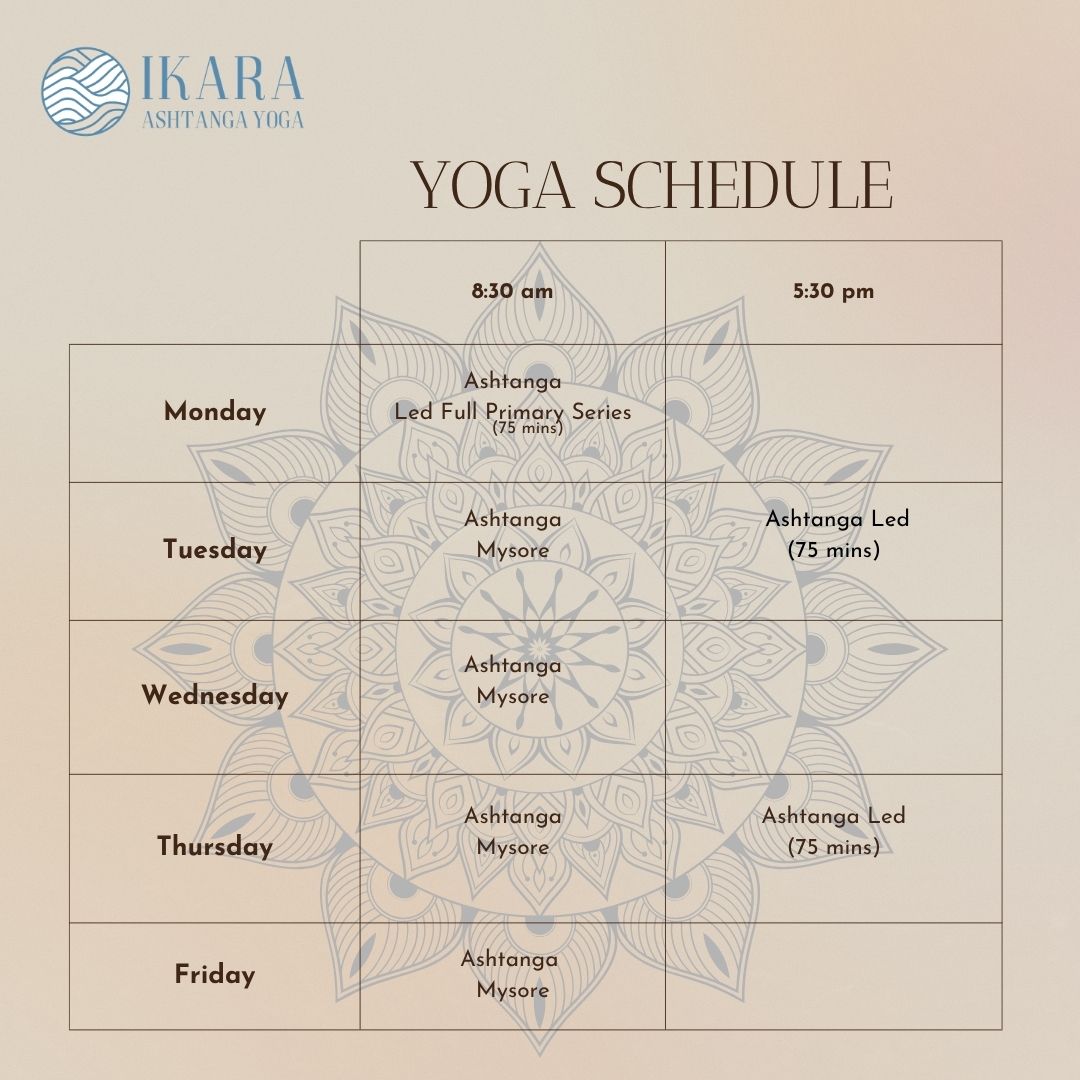
YOGA SCHEDULE
The following schedule is open to all students of all levels. Single classes and passes are available.
| Rates | IDR |
Drop In 3 Class 5 Class 10 Class 1 Month | 130,000 350,000 550,000 1’000,000 1’800,000 |
| Special Price for Kitas and KTP holders. |
Private Classes
| 60 mins | ||
| Rates: | IDR | |
| 1-2 people | 900,000 | |
| 3-4 people | 1’000,000 | |
| 5 people | 1’050,000 | |
| 6 people | 1,100,000 | |
| 7 people | 1,150,000 | |
| 8 people | 1,200,000 |
Mysore Style
Multilevel Class
Mysore-style Ashtanga is the traditional method of learning Ashtanga Yoga as taught by Sharath Jois of the Sharath Yoga Center SYC. Is a self-practice within a group setting, where each student moves through the sequence of poses individually.
The instructor moves around the room adjusting and correcting, working one-on-one with the practitioners. As postures are learned and memorized; students become steady in their practice. Subsequent postures are taught and integrated into their existing practice. In this way, students are gradually able to build strength, stamina and flexibility.
Initially is not necessary to know the sequence to participate, eventually each student will learn it with the guidance of the teacher. The teacher will assess each student to provide specific recommendations in order to improve the learning process. The main requirement is the commitment to a steady and consistent practice. Mysore are group classes mostly in silence. As students arrive and move through their practice independently, they receive adjustments and instruction as needed.
Ashtanga Vinyasa
Led classes, on the other hand, are guided group classes, wherein the teacher leads students through the practice as a group, while counting out the names of the postures and vinyasas in Sanskrit. Practice is recommended six days a week. Only resting Sundays and Moon days.
Yoga for Surfers
Yoga for surfers is a specialized practice designed to enhance the physical and mental skills needed for surfing. It focuses on improving flexibility, balance, and mindfulness, all of which are essential for navigating waves effectively. Here’s a deeper look at how yoga benefits surfers:
Benefits of Yoga for Surfers
Flexibility:
Yoga stretches key muscle groups, particularly in the hips, back, and shoulders, which can become tight from paddling and balancing on the board.Breath Control:
Breathwork in yoga (pranayama) teaches surfers how to manage their breath, enhancing endurance and relaxation while riding.Injury Prevention:
Increased flexibility and strength reduce the risk of injuries, particularly in the lower back and shoulders.Mindfulness:
Yoga promotes mental focus and clarity, helping surfers stay calm and centered in challenging conditions.
Restorative Yoga
Restorative yoga is a gentle, calming practice designed to relax the body and mind. It typically involves long-held poses supported by props like blankets, bolsters, and blocks to facilitate deep relaxation. The focus is on slowing down, letting go of tension, and nurturing the body, making it a great way to relieve stress, improve flexibility, and promote overall well-being.
Mat Pilates
Mat Pilates is a form of exercise performed on a mat, designed to improve core strength, flexibility, and overall body alignment. Unlike equipment-based Pilates, which uses specialized machines like the Reformer, mat Pilates relies on the body’s own weight and gravity to create resistance. The exercises often focus on controlled movements and precise breathing to engage and strengthen the core muscles, enhance posture, and support overall physical fitness. Pilates is named after it’s inventor, Joseph Pilates, who formulated the exercises in the 1920s. There are 34 original Pilates movements. The Pilates exercises are built around eight principles: concentration, breathing, centering, control, precision, movement, isolation and routine.
Moon Days
Both full and new moon days are observed as yoga holidays in the Ashtanga Yoga tradition. What is the reasoning behind this?
Like all things of a watery nature (human beings are about 70% water), we are affected by the phases of the moon. The phases of the moon are determined by the moon’s relative position to the sun. Full moons occur when they are in opposition and new moons when they are in conjunction. Both sun and moon exert a gravitational pull on the earth. Their relative positions create different energetic experiences that can be compared to the breath cycle. The full moon energy corresponds to the end of inhalation when the force of prana is greatest. This is an expansive, upward moving force that makes us feel energetic and emotional, but not well grounded. The Upanishads state that the main prana lives in the head. During the full moon we tend to be more headstrong.
The new moon energy corresponds to the end of exhalation when the force of apana is greatest. Apana is a contracting, downward moving force that makes us feel calm and grounded, but dense and disinclined towards physical exertion.
During Moon Days all classes will be suspended, please check the Moon calendar to identify these days:

Mysore is known as the Ashtanga yoga capital of India. The style was developed by Sri Krishna Pattabhi Jois, who founded the Ashtanga Yoga Research Institute (now known as the K Pattabhi Jois Ashtanga Yoga Institute) in Mysore in 1948. He was a disciple of Sri T Krishnamacharya, who’s regarded as one of the most influential yoga teachers of the 20th century. Sri K Pattabhi Jois passed away in 2009, his teachings are now carried on by his son Manju Jois, his daughter Saraswati Jois and grandson Sharath Jois, founder of Sharath Yoga Center (SYC).
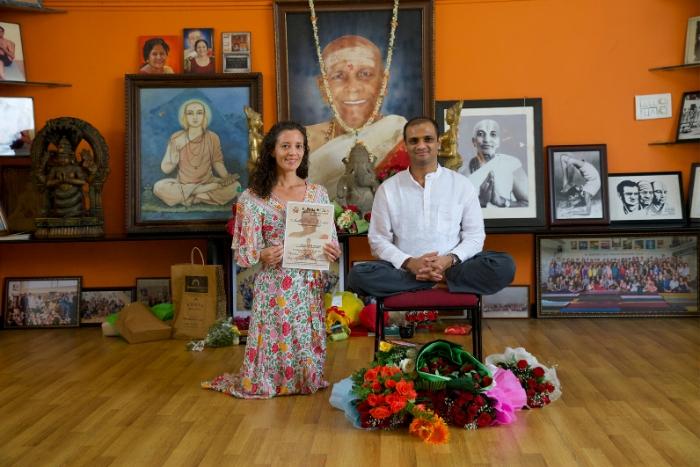
Marilu is a direct student of Sharath Jois.